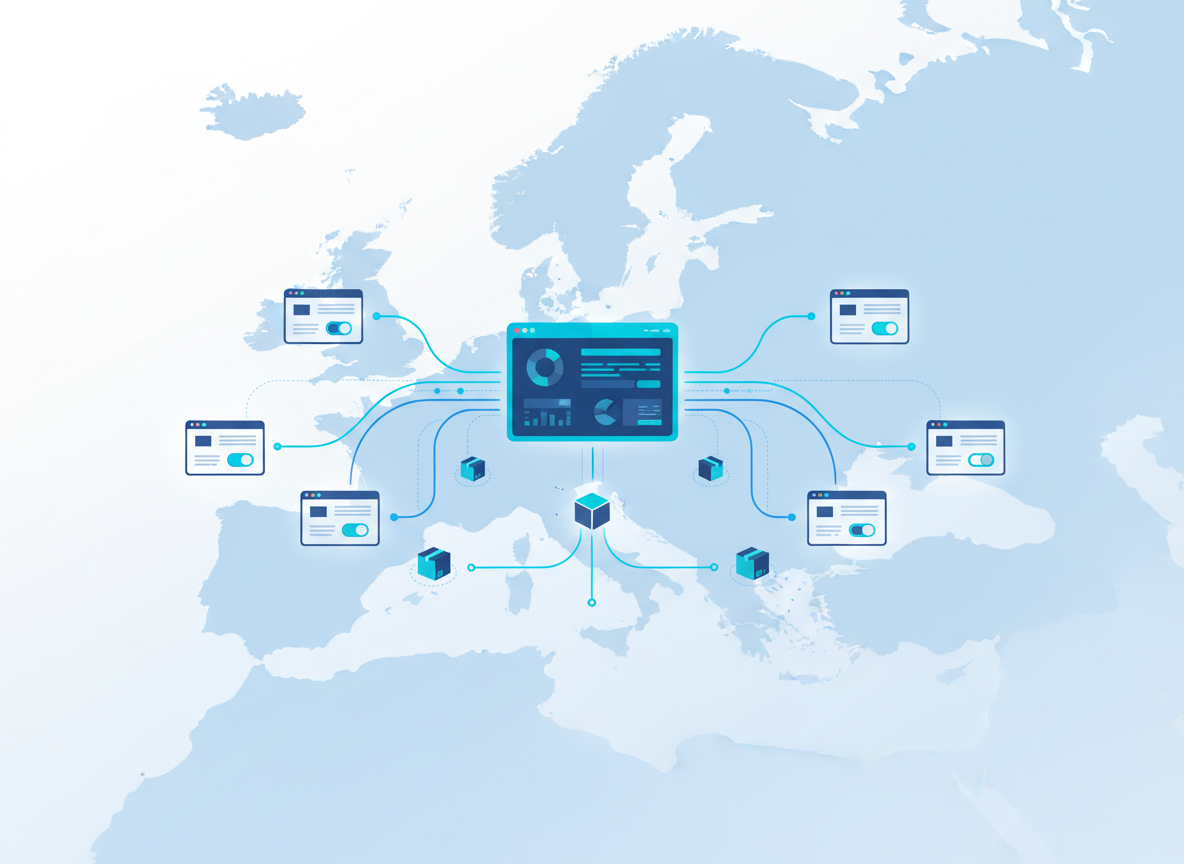
Expanding internationally sounds like the logical next step once you’ve gained traction in the Netherlands or Belgium. A bigger market, more revenue, more room to grow. In reality, things often go wrong in the same areas: translations, local expectations, SEO structure—and, most of all, the operations behind the scenes. Because as soon as you serve multiple countries, you don’t want to end up with separate shops that each have their own stock, pricing and content.
In this blog, you’ll learn what to focus on in cross-border e-commerce—and how to set it up smartly with one central operation.
1. Choose your international setup: subfolder, subdomain or separate domain
The first strategic decision is how you technically structure your country and language versions. Broadly, you have three options.
A subfolder, for example /de/ or /fr/. This is often the clearest option for SEO, because your authority stays on one domain.
A subdomain, for example de.yourdomain.com. This can be useful if you want to separate teams or platforms, but Google more often treats it as a separate entity.
A separate domain per country, for example yourbrand.de or yourbrand.fr. This is strong for local positioning and trust, but it requires a disciplined approach to content, SEO and operations—because you’re essentially running multiple shops.
Many retailers ultimately choose a separate domain per country. And that’s exactly where complexity increases.
2. Translation is not the same as localisation
A literal translation rarely performs well. Localisation goes further.
You adapt tone of voice to culture and buying behaviour. You use local terms and sizing. You align shipping and returns information with local expectations. And you make sure payment methods and trust elements match what customers in that country expect.
This is also where duplicate content and SEO risks appear. If you copy the same product texts one-to-one to another domain, you’re more likely to compete with yourself and lose local relevance.
3. Multi-country SEO: make sure Google understands what belongs to which country
International SEO is all about clarity. You want search engines to understand which page is intended for which language and region.
That’s where hreflang settings matter, along with a consistent URL structure and local content that truly differs where it needs to. Especially with separate domains, it’s essential to build country pages with their own context, their own category introductions, and—where needed—their own product copy.
4. The biggest pitfall: fragmented stock and manual management
The real pain usually isn’t launching—it’s keeping everything running.
As soon as you add a second country shop, you run into questions like: which stock is the source of truth, how do you prevent overselling, how do you keep pricing consistent, and how do you make sure product updates go live everywhere at the same time?
If you solve this with exports, imports and manual checks, your operation won’t scale. Your team becomes the bottleneck.
5. How JUST IN SYNC makes international growth easier
JUST IN SYNC is built for multistore retailers who want to manage multiple webshops from one central environment.
What this means in practice for international expansion:
You can run another language on a separate domain, while still managing your product data from the same central source. You sell from the same stock, without having to maintain separate inventory administration per country shop.
JUST IN SYNC also helps you manage and vary content per shop. That way, you can implement local differences without doing everything twice. And with AI support, you can create product descriptions and metadata faster—tailored to language, audience and channel—while staying consistent in brand and structure.
The result is an international setup that feels like one operation, instead of multiple separate stores.
6. Practical checklist for your first international launch
- Choose your countries based on demand, competition and logistical feasibility.
- Decide on your domain strategy and create an SEO plan per country.
- Localise content, customer support and payment methods.
- Centralise your inventory and order process so you don’t end up “maintaining” each shop separately.
- Create a content profile per country shop so tone of voice and USPs match.
- Automate where possible, and keep review moments in place for quality.
Conclusion
International growth isn’t just a matter of switching on an extra language. It’s an operational decision. If you do it well, you can scale faster with more control and less manual work. With JUST IN SYNC, you can launch an extra language on a separate domain and sell from the same stock, while keeping content and processes centralised—exactly what you need to make cross-border growth manageable and profitable.