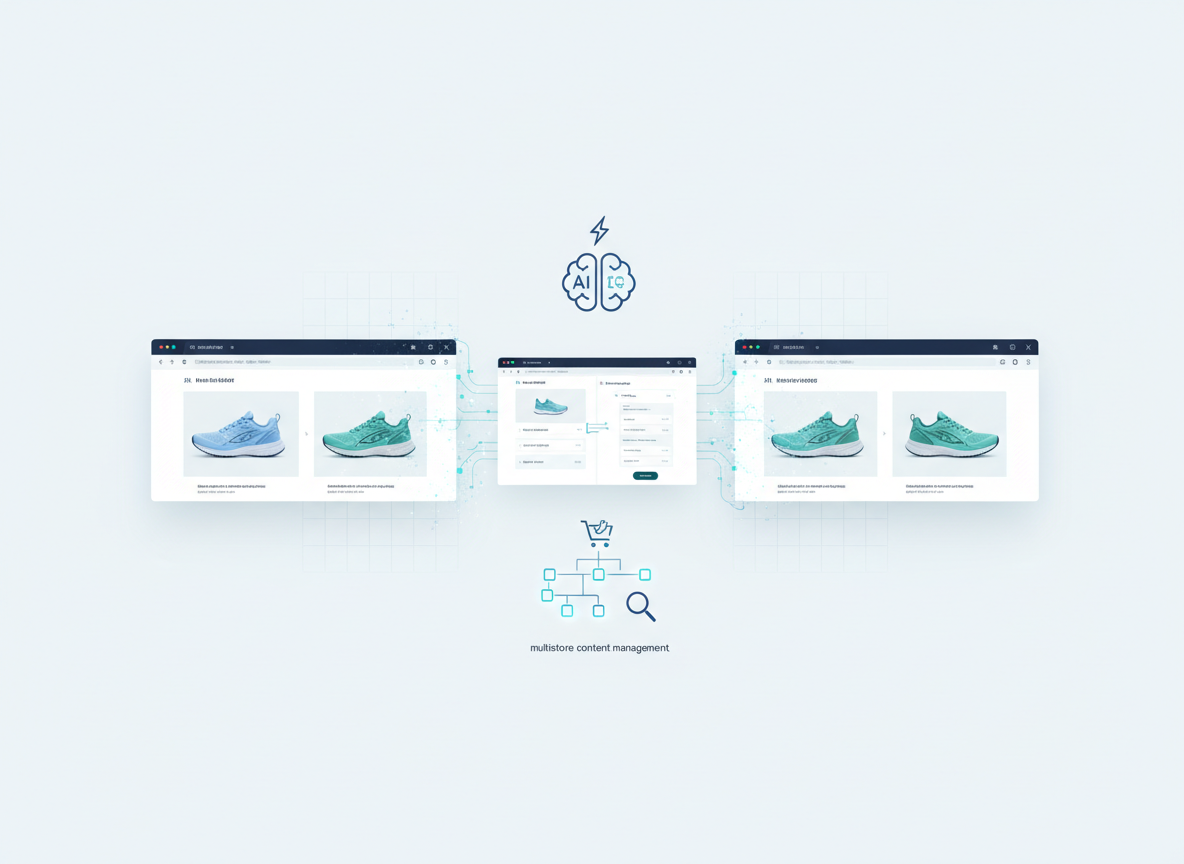
Running multiple webshops is often a sign of growth. But it also comes with a classic SEO problem: duplicate content. When the same (or nearly the same) product texts, category pages and meta data appear across multiple shops, it becomes harder for search engines to determine which page is the “right” one. The result: less visibility, internal competition between your own shops, and a lot of unnecessary manual content work.
In this blog, you’ll learn what duplicate content actually is, why it happens so often in multistore setups, and how AI helps you create scalable, unique content—while keeping your brand consistent. We’ll also explain how JUST IN SYNC supports this process in practice.
Duplicate content means that large parts of content are identical or very similar across multiple URLs. This can happen within a single webshop, but in multistore environments you’ll mainly see it when multiple webshops share the same product range, when country or language variants are too similar, when B2B and B2C shops use the same product copy, or when seasonal or outlet shops copy product pages.
Important: duplicate content is not necessarily a “penalty”, but it can still lead to weaker rankings because authority and signals get split, the wrong page ranks (or neither does), and crawl efficiency drops because Google spends time on duplicates.
In a multistore environment, copying is often the fastest route. Product data comes from one PIM, ERP or supplier feed. Teams want speed and consistency. Content gets “quickly” pushed to shop 2, 3 and 4. That makes sense—until you notice SEO performance lagging and your content team spending most of its time copying, pasting and fixing.
AI is strong at creating scalable variations of text based on the same source data. Think of unique product descriptions per webshop or per audience, variation in headings and subheadings, alternative meta titles and meta descriptions per shop, and a consistent tone of voice—as long as you provide clear guidelines.
AI works best when you use it for bulk variations across hundreds or thousands of products, template-driven copy with a fixed structure and variable accents, and audience differentiation such as B2B versus B2C, premium versus outlet, or the Netherlands versus Belgium.
AI is not a “switch it on and you’re done” button. Watch factual accuracy, because AI can fill in details that aren’t in your data. Watch brand language, because without style rules it quickly becomes generic. And watch over-optimisation, because too many SEO keywords can make copy harder to read.
The sweet spot is using AI to accelerate eighty percent of the work, and letting your team steer the final twenty percent for nuance, brand and conversion.
Define a single source of truth for product data and content. Create a content profile per shop with audience, tone of voice, USPs and forbidden words. Generate variations with AI based on the same data model. Use canonical and hreflang where needed—especially for country and language variants. Measure impact on indexation, rankings, CTR and conversion per shop.
If you manage multiple webshops, you want two things at the same time. Consistency, because pricing, stock and product data must be correct. And differentiation, because content needs to be unique and relevant per shop.
JUST IN SYNC – INTERACTiVE ECOM is built for multistore retailers who want to manage product content, pricing, stock and orders from one central environment. Especially for content, AI helps you work at scale: generate unique meta titles and product descriptions faster—without losing control of your content process.
Want to solve duplicate content structurally without overloading your team? Book a short demo and discover how